Five Animal Frolics (Wuqinxi, 五禽戲). For a very nice YouTube example of this set, see Dr. Alex Hui's site: https://youtu.be/98AliPKDtFk?list=PLrbcKznPYcDSuXS4K8el-auMuWILLQXhh
- Bear → lead qi to the lower energy reservoir (core area)
- Bear claws. Walk like a bear.
- Rock, step like a bear: lift arms gently, push down, rock left,
right.
- Nurture qi at the lower reservoir.
- Reach up, down, behind, like a bear marking a tree.
- Rock, step one foot forward, reach, push down in front with bear paws, like looking for fish.
- Deer → a key to longevity is lifting the feet when stepping
- Deer horns. Either gentle fists or antlers. Rock arms forward and back with one foot forward. Put weight on back foot and lean back. Change forward foot and repeat.
- Rock arms swinging, index and pinky like antlers; step out with foot turned, reach, point over foot.
- Step, push fists, withdraw/curve back with antlers together (backs of hands together), push fists.
- Tiger/Cat → lead qi to the central energy reservoir (heart
area)
- Tiger paws. Claws in, fists together; circulate qi around belly, one direction then the other.
- Claws out. Rock arms in circles with one foot forward. Change forward foot and repeat.
- Claws out. Rock, rotate, big step forward with gentle cat's paw, lifting; then step back, pushing down.
- Monkey → lead qi to the upper energy reservoir (head/eyes area)
- Monkey paws. Swing horizontally.
- Circle hands in front, lift both up at center, on tiptoes, look left, then repeat, look right.
- To the left, step back into "sleeping dog" (also called "drunken monk") pose, then step out to the right, sweep down, reach high, grabbing with left hand. Repeat in the other direction.
- Bird → taiji: integrate yin and yang qi; balance of
left, right, center line, up and down
- Bird wings. Rock vertically, moving both hands like wings. One foot forward. Gently raise back leg. Repeat with other leg forward.
- Rock horizontally, sweeping hands in front. Lift both hands and one leg. Do one "wing flap" with leg raised. Repeat with other leg.
- Wave arms in front, bend forward, reach back, arch back while lifting one leg. Repeat with other leg.
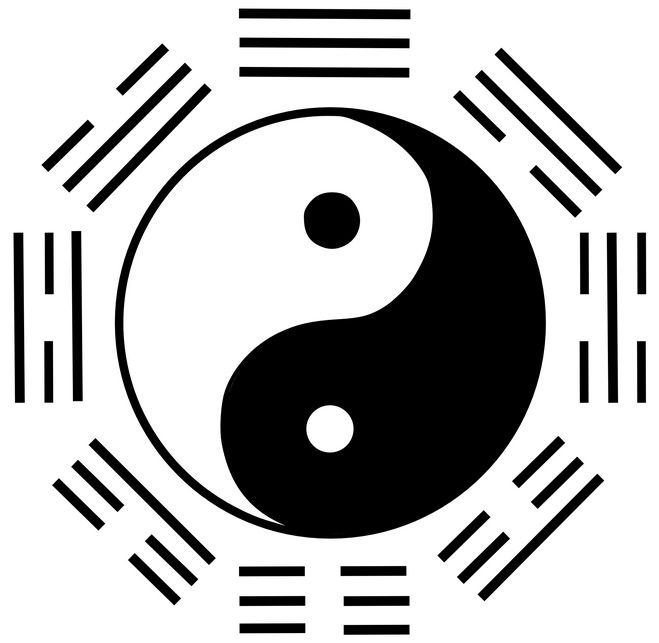
Taiji ("supreme ultimate") refers to the never-ceasing interchange of yin and yang energies. From still, centered nothingness (wuji) of the Great Course (dao), yin and yang energies emerge and intertwine, developing into the universe of all things, including living things.
Bagua ("eight trigrams") refers to eight fundamental ways in which yin and yang coalesce from taiji in order to take form, the most fundamental being fire (all-yang) and water (all-yin).
Wuji ("unbounded") refers to the state of the universe (the great Way) prior to the emergence of taiji and then bagua.