The science of qigong.
Qigong Exercise Balances Oxygen Supply and Acid-Base to Modulate Hypoxia: A Perspective Platform toward Preemptive Health & Medicine. Published in 2023 by the NIH National Library of Medicine, USA (https://www.ncbi.nlm.nih.gov/pmc/articles/PMC10057714/) and in Medical Sciences, Basel, Switzerland (https://www.mdpi.com/2076-3271/11/1/21). The authors are from Shenzhen University, School of Medicine, Guangdong, China, and the UC Irvine School of Medicine.
From the abstract:
We propose a novel mechanism by which the "acid" caused by hypoxia affects metabolism, and the way it is neutralized through Qigong practice involves the body's blood flow and vasculature modifications. Specifically, Qigong exercise generates an oxygen supply and acid-base balance against the hypoxic effects of underlying pathological conditions. We also propose that Qigong exercise mediated and focused on the local hypoxia environment of tissues might normalize the circulation of metabolic and inflammation accumulation in the tumor tissue and restore the normal metabolism of tissues and cells through calm, relaxation, and extreme Zen-style breathing that gravitates toward preemptive health and medicine.
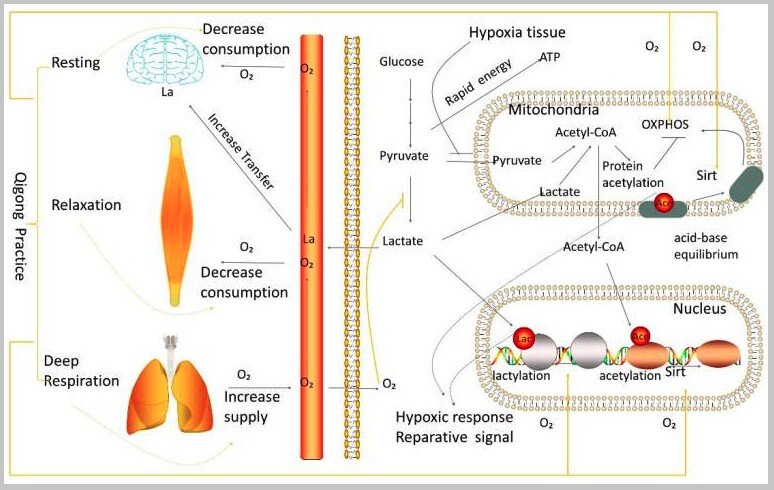
Schematic representation of metabolic oxygen level, lactate, and acid-base equilibrium in brain, muscle, lung, blood, heart, and liver, as modulated by Qigong practice. The orange lines represent the state of Qigong practice. The final metabolic step in the synthesis of adenosine triphosphate is the mitochondrial oxidative phosphorylation (OXPHOS) system (ATP). The genes for the five multiprotein complexes that comprise the OXPHOS system, Complex I through Complex V, are encoded by the mitochondrial (mtDNA) or nuclear genomes (nDNA). For effective OXPHOS activity, close to 300 proteins are required, and O₂ controls OXPHOS activity. The metabolic pathway known as OXPHOS, also known as electron transport-linked phosphorylation or terminal oxidation, is where cells use enzymes to oxidize nutrients to release chemical energy and produce 30 to 32 ATP molecules. This OXPHOS action contrasts glycolysis, an independent form of OXPHOS, and only has 2 ATP molecules. The OXPHOS, which generates roughly 90% of the ATP molecules produced in the brain, drives neuronal activity processes such as pre- and postsynaptic action potentials, neurotransmitter release, and postsynaptic currents. Substrate feedback inhibition, protein stability, mtDNA and nDNA transcriptional regulation, translational effects via RNA levels, and post-translational changes such as phosphorylation, acetylation, and lactylation tightly regulate OXPHOS.
On the role of oxygen and oxygen depletion in the formation of ATP
Muscle contractions produce force and heat, which looks like mechanical energy but consumes chemical energy from ATP. When we exercise, our muscle cells contract and undergo a series of metabolic activities that produce various metabolites and heat. Fatigue and muscle soreness are the most common symptoms after strenuous exercise. The intracellular lactic acid accumulation is a disadvantage during muscle activity [12], thereby decreasing pH that is believed to be involved in muscle fatigue, which results from ionic changes on the action potential, extracellular and intracellular ions, and many intracellular metabolites, failure of sarcoplasmic reticulum (SR) Ca²⁺ release by various mechanisms, and the effects of reactive oxygen species [13]. No matter what exercise we do, we end up feeling tired or exhausted. The accumulation of metabolites protects our bodies from harm by the perception of tiredness, which can reduce physical activity or stop performance. … Extensive exercise consumes oxygen as well as energy quickly. Therefore, our bodies need to obtain energy and reduce oxygen consumption as soon as possible, which drives the energy metabolism of cells to glycolysis for rapid energy ATP and less oxygen consumption (Figure 1). … Although lactate and pyruvate can be transferred to mitochondria for more energy production under normal circumstances, the need for rapid energy and insufficient oxygen supply during intensive exercise drives the glucose metabolism in muscle tissue from normal aerobic respiration to glycolysis, resulting in the accumulation of lactate.
…
Under normal circumstances, the human brain consumes 20% of the body's total energy requirement with slightly more than 2% of adult body weight [17]. Qigong exercise's resting and relaxing state effectively reduces oxygen consumption in significant oxygen-consuming tissues such as the brain and muscles to relieve the body's hypoxia. The cells resume aerobic respiration, and glucose metabolism returns to the high-energy, productive pathway in mitochondria through oxidative phosphorylation. Resting and relaxing states reduce the body's energy requirement and the need for rapid energy replenishment. Lactate, the final product of glycolysis, can re-enter mitochondria for oxidative phosphorylation and obtain more ATP. Deep breathing during the Qigong exercise maximizes oxygen exchange in the lungs, increasing blood oxygen levels and ensuring the need for oxygen in tissues throughout the body. Therefore, Qigong exercise provides oxygen supply and high-productive energy metabolism in tissues by reducing oxygen consumption, reducing the need for rapid energy replenishment, and increasing blood oxygen levels. Therefore, Qigong exercise can quickly rejuvenate anoxic tissues and reduce fatigue or damage caused by harmful substances or tissue acidification.